
In this article+
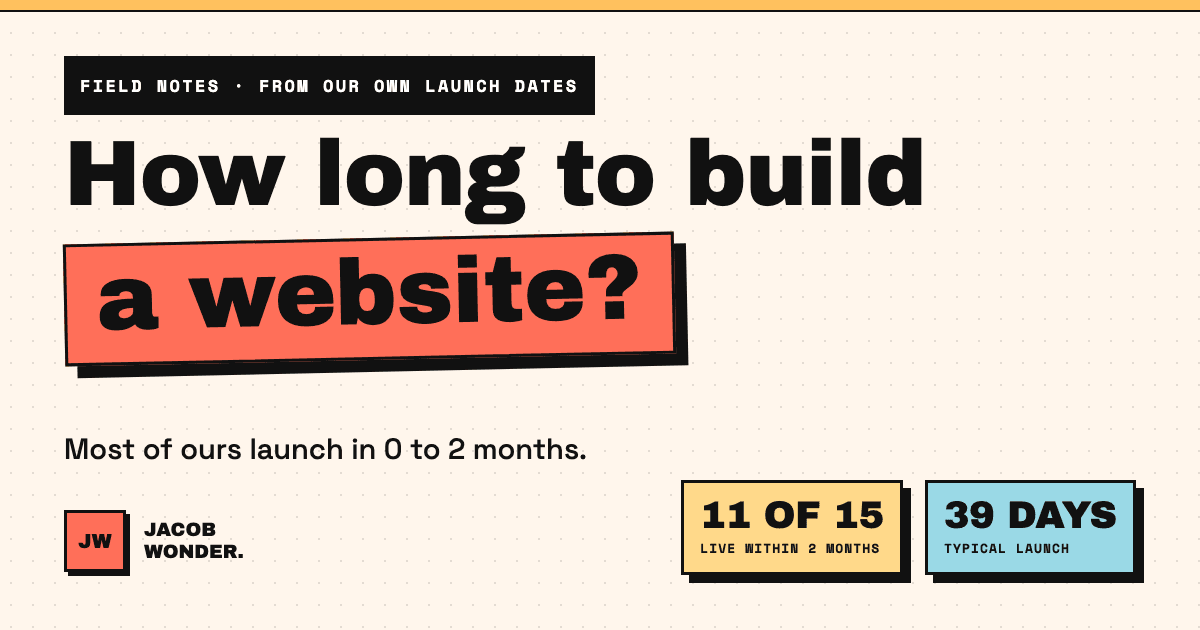
How long does it take to build a website? Most sites my team builds launch in 0 to 2 months. Before writing this I checked that line against our own project dates. Of 15 new sites and rebuilds we started since January 2025 and have launched, 11 were live within two months of the start, and the typical one took 39 days.
I’ve been building websites since 2008, my team has built more than 282 of them, and five agencies send us their clients’ sites to build. So I have a lot of start dates and launch dates to look at, and they say the same thing I tell owners on a first call: the building is the quick part. Most of the rest of the calendar goes to things only you can give us.
How long does it take to build a website?
Most websites my team builds launch in 0 to 2 months. Of 15 we started since 2025 and launched, 11 were live within two months of the start.
Those 15 are new websites and 1:1 rebuilds, meaning the same site rebuilt clean or moved to a new platform. Counted from the deposit (or the kickoff, when there was no deposit) to the day the site went live:
- 11 of the 15 launched within two months (60 days).
- The typical project took 39 days, a little under six weeks. That is the median, the middle one when you line all 15 up from fastest to slowest.
- The fastest was a clean 1:1 rebuild that went live 7 days after kickoff.
- The 9 brand new builds ran a little longer than the rebuilds. 5 of the 9 launched within two months, and the middle one took 51 days, about seven weeks.
| Start to launch | Sites (of 15) |
|---|---|
| 30 days or less | 5 |
| 31 to 60 days | 6 |
| More than 60 days | 4 |
A note on how I counted, so you can judge the numbers for yourself. They cover new sites and rebuilds we started since January 2025 that have launched. The clock starts when the deposit is paid, or at kickoff when there was no deposit, and stops at go-live. Where nobody logged a go-live date, I used the date of the final payment, because I bill the balance when a site goes live.
Redesigns are not in these numbers. Giving an existing site a new design is a different job with its own timeline, and my team’s website redesign guide covers how those run.
For comparison, Wix’s guide to the same question puts a build by professional developers at 2 to 5 months, and says building a website in general can take from around one to six months.
Why do some websites launch in a week while others take two months?
The building itself is usually the short part. The calendar mostly follows how ready the content is and how fast decisions and approvals come back.
Two of our fastest launches show how short the hands-on work can be. One was the clean 1:1 rebuild I mentioned: same design, same content, rebuilt from scratch and live in 7 days. The other was a one-page site that went live in 15 days. Building it took about a day. The rest of those two weeks went to search setup, forms and email, and waiting on the domain switch.
Design moves quickly too. On 10 projects where I have both dates, the first homepage design came back between 1 and 7 days after the brief, and the median was 3.5 days.
So when a project takes the full two months, in my experience the extra weeks usually go to things only the business can supply: the words, the photos, the answers to questions and the final yes. That is normal. You have a business to run, and your website is one of forty things on your list. It does mean you have more control over your launch date than you might think.
How long does each phase of a website build take?
Kickoff and a first homepage design take days. Content, review rounds and launch setup take as long as the people involved need, and that is where a timeline stretches.
| Phase | How long |
|---|---|
| Kickoff and brief: the pages, the goal of the site and examples you like | A call and a written brief |
| Homepage design | 1 to 7 days after the brief on our projects (median 3.5) |
| Content: the words and photos for every page | The widest range of any phase |
| Inner pages, built from the approved homepage | Days for a one-page site or a 1:1 rebuild, longer as pages and features are added |
| Review and changes | As fast as feedback comes back |
| Launch: domain, DNS, email, forms, redirects and tracking | Short when the logins are on hand |
Kickoff is where the page list gets decided, and a settled page list protects everything after it. A page added in week five means new design work, new copy and another round of review.
We design the homepage first because it carries most of the decisions: fonts, colors, buttons, the way sections stack on a phone. Once you’ve approved it, the inner pages reuse those pieces, so they go faster and need fewer opinions.
Content is the phase nobody can do for you entirely. A writer can draft the copy, but someone at the business still has to supply the facts and approve the result. Photos are the same. Stock photos are quick, and real photos of your team and your work are worth the wait, so the shoot needs a date early.
Launch looks like a single day from the outside. Behind it is a checklist: point the domain at the new site, move or protect the email, test every form, set up redirects and turn on tracking. The domain step has a wait built in that nobody controls. GoDaddy’s help page says DNS changes usually spread within a few hours but can take up to 48 hours to reach everyone.
What actually delays a website launch?
Mostly things outside the build: photos, written content, a decision or final sign-off, access to the domain, or a third-party account that isn’t approved yet.
Four of our 15 took longer than two months. Across my project notes, the same five things come up whenever a launch is waiting.
- Photos. Real pictures of the team, the location or the products usually mean booking a shoot, and an online store needs a photo of every product it sells.
- Written content. Somebody has to say what the business does, who it serves and why a customer should pick it, and that somebody is busy running the business.
- A decision or sign-off. A service gets renamed, the page list changes, or the one person who can approve the site is hard to reach and every answer gets relayed through someone else.
- Domain and DNS access. The login for the domain sits with a former employee, a previous web company or an account nobody has opened in years. This one tends to surface in the last week.
- Third-party setup. A payment processor has to approve the account, or a booking system has to be configured, before the site can take money or reservations. For restricted products, the processor reviews the website itself first, which shapes how to build a peptide website that gets approved.
Other builders describe the same pattern. Wix’s guide says most website projects run long for reasons that have nothing to do with the tools, and that “the biggest one is content.” Elementor’s timeline guide calls a lack of prepared content “the number one reason website projects stall.”
Most of that list can be sorted out before the project starts, which is good news if you have a date to hit.
How long does it take to build a small business website?
Plan on 0 to 2 months for a typical small business website. A one-page site or a straight rebuild of an existing site can be live in a week or two.
The kind of site moves the number more than the kind of business does.
- A one-page site or a 1:1 rebuild is the fastest, because the content already exists. Those are the 7-day and 15-day launches above.
- A new multi-page site needs a design, new copy and photos. One we built for an agency partner’s client went live 51 days after the deposit.
- An online store adds products, payments, shipping and tax settings. A Shopify store we built launched 33 days after kickoff.
If you only need to exist online by next month, say so at the start. A good builder can launch a small first version with the pages that sell, then add the rest after launch. That beats holding the whole site back for one unfinished page.
Timeline and price are tied together, since both come down to how much is custom and who supplies the content. I wrote up the price side in how much a small business website should cost.
How long does it take to build a WordPress website?
The same 0 to 2 months for most. Installing WordPress takes minutes. The time goes into design, content and review, the same as on any other platform.
WordPress.org says a standard install “takes less than five minutes to complete,” and many hosts install it for you automatically.
My numbers are WordPress numbers in practice. 14 of the 15 sites run on WordPress, two of them as online stores on WooCommerce. The other one is the Shopify store.
What changes a WordPress timeline is how much of the site is new. Rebuilding an existing design is quick. A custom design takes longer because every section gets drawn and approved. A store, a booking system or a member login each add setup and testing. Moving hundreds of pages from another platform adds a content check on every page.
If you run an agency and your own client is waiting on the answer, my post on white label web design covers how a build works when a partner does it under your name.
How long does it take to design a website?
Design is the fast part. On 10 of our projects, the first homepage design came back a median of 3.5 days after the brief.
The quickest came back the next day and the slowest took a week. That’s the first version of one page, which is the right amount of design to look at first. You’ll have opinions once you see it, and it’s cheaper to hear them before the other pages exist.
What stretches the design phase is the rounds of feedback after that first version. One person with clear notes can settle a homepage in a round or two. A committee where everyone comments separately takes much longer, and the notes often contradict each other.
If you’re sketching a website design timeline for your own project, give the homepage about a week, then block time on your own calendar to review it the day it arrives.
How can you get your website built faster?
Have your content, photos and logins ready before kickoff, name one person who approves things, and answer review requests within a day or two.
- Write the content first, even as a rough draft. Bullet points about each service are enough for a writer or designer to work from.
- Book the photo shoot the week you sign. Photographers have their own queue.
- Name one decision-maker. Other people can weigh in, but one person gives the final yes.
- Find your domain login now. Know where the domain is registered, who has the password and where your email is hosted.
- Apply for third-party accounts early. Payment processors and booking systems run on their own schedule.
- Approve the homepage before anyone builds the inner pages.
- Pick a real date. A trade show, a busy season or a grand opening gives everyone a reason to answer quickly.
Have a launch date in mind? Book a call with me and I’ll tell you whether it’s realistic and what we’d need from you to hit it.
What should you ask a web designer about the timeline?
Ask when they can start, what they need from you and by when, how many review rounds are included, and who handles launch day.
The start date matters as much as the build time. A six-week build that begins in three months is a four-and-a-half-month wait, so ask where you’d sit in the queue.
Ask for the list of what they need from you, with dates. If a builder can’t tell you what they’re waiting on at each step, nobody is managing the calendar.
Then ask what happens at launch. Somebody has to move the domain, test the forms and check that email still works. Make sure that’s in the quote and has a name next to it.
Is a website finished when it launches?
No. Launch day starts the part most owners skip: checking forms and tracking, getting the pages into Google, and keeping the site working month after month.
A new site doesn’t appear in Google the day it goes live. Google’s own documentation says crawling can take anywhere from a few days to a few weeks, so submit your sitemap in Search Console on launch day and expect a short wait.
The first month is also when small problems show up on any new site, like a form that isn’t emailing the right inbox or a redirect that got missed. My post on website redesign SEO has the launch-day checks and a first-30-days list that apply to new sites too.
After that, a website needs someone looking at it. I wrote a research paper, The Post-Launch Gap, on what goes wrong with small business websites after they go live. Ask about care after launch in the same conversation as the timeline.
Website timeline FAQ
Can a website be built in a week?
Yes, if it’s a one-page site or a 1:1 rebuild and the content is ready. The fastest of the 15 sites in my numbers was a clean rebuild that went live in 7 days. A new multi-page site with fresh content takes longer.
How long does it take to make a website yourself?
With a website builder and a template, a simple site can be up in days if your text and photos are ready. The hours come out of your own week, and the writing is usually the slow part.
How long does a one-page website take?
A week or two when the content is ready. One we launched in 15 days needed about a day of building. The rest was forms, email and the domain switch.
How long does a website redesign take?
A redesign is a different job from a new build, because the old site’s pages, rankings and redirects have to carry over. It isn’t counted in the numbers on this page. My team’s website redesign guide covers the steps and the timing.
How much does it cost to build a website?
It depends on scope. Most small businesses pay $3,000 to $8,000 for a good custom website in 2026, plus a monthly care plan. I break the ranges down in how much a small business website should cost.
How long after launch does a new website show up on Google?
Google says crawling can take anywhere from a few days to a few weeks. Submit your sitemap in Search Console on launch day so Google knows the pages exist.